Gunny,
Having done this recently, I can share how I did it in my T-Hangar. The good news is, if you have everything set up in advance with all the parts/hardware/tools ready to go, the actual time on jacks (or hanging) can be minimized to an hour or so. Bolting them in is pretty strait forward, but most time will be spent setting the wedges. There's really no way to know what you will need for the shim thickness until you have the legs bolted in. But getting to the point...
I fabbed some "jack pads" out of sheet alum and a wooden block that attaches to the wing just outside the lift struts, centered on the main spar. Just take the screws out of the inspection plate, and screw in the jack pad using the inspection cover holes. This secures the pad to the wing and assures correct alignment under the main spar. It's best to have the tail elevated to have the wings as level as possible (chord wise), to avoid any potential stresses on the jack pads bolted to the wing...I used a 55gal drum which raised it 3-1/2 feet or so. DONT FORGET to weight the tail down, the CofG is forward of the main spar when unloaded.
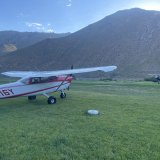
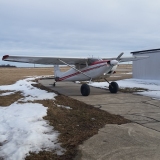
I purchased two high lift jacks from "Harbor Freight Aircraft Supply" that had a telescoping pad. ($69 apiece). I originally thought to use these after lifting the plane with a forklift from the engine mount, but realized later that there was enough travel in the jacks to get the tires off the ground by themselves. I could go on about the intricacies involved in this process, but suffice it to say, "think things through carefully". I'll just include some pics

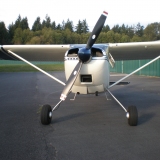
This pic was taken afterward so the tail isn't raised, so you can see the incorrect geometry...

The jack pad. The wooden block is screwed to the alum, and there is padding on the underside to protect the paint...

Another angle...

In a precarious position...